


The word often appears after riots, wars, evacuations, and major emergencies. Yet headlines sometimes use it more broadly than its basic meaning supports.
Short answer: Looting is the taking of goods or property during disorder or a crisis, such as a riot, disaster, or armed conflict. In everyday use, it usually refers to opportunistic theft when normal controls are weakened. During war, similar conduct is commonly referred to as pillage, which is prohibited under international humanitarian law. Elsewhere on the site: Expropriation.
| Context | What is happening | Useful distinction |
| Civil unrest | Property is taken during public disorder | Theft and rioting are separate acts |
| Natural disaster | Property is taken during an emergency or evacuation | Widespread stealing is not inevitable |
| Armed conflict | Property is unlawfully appropriated during war | International law commonly uses the term “pillage” |
| Store or home | Property is taken without permission | Theft, burglary, or robbery may be the relevant offense |
Key takeaway: The surrounding event matters. Stealing during a riot is different from rioting itself. Research on disasters also challenges the assumption that major emergencies automatically cause widespread criminal behavior. During armed conflict, international humanitarian law applies a separate and stricter framework to pillage.
What Looting Means in Plain English

The term generally refers to theft from shops, homes, or other places during violent events, emergencies, war, or public disorder. The shared idea is the unauthorized taking of property when normal controls have weakened or broken down.
The surrounding crisis helps distinguish this kind of conduct from ordinary shoplifting or theft. A smashed storefront during civil unrest is one common example. Property taken from an abandoned building after an evacuation may create a similar context.
The label should not be applied to everyone present at an event. A protester, a bystander, a rioter, and someone stealing merchandise may all be engaged in very different conduct.
How Looting Differs From Theft, Robbery, Burglary, and Rioting
Everyday reporting often mixes several crime-related terms. Their meanings are not interchangeable, and precise criminal definitions vary by jurisdiction.
| Term | Basic idea | What separates it |
| Theft | Taking another person’s property without permission | Force against a person is not required |
| Robbery | Taking property through force or threat | A person is directly threatened or confronted |
| Burglary | Unlawful entry connected with criminal intent | Entry into a protected place is central |
| Rioting | Collective public disorder or violence | Property does not need to be stolen |
| Pillage | Unlawful appropriation during armed conflict | It falls under international humanitarian law |
That is why looting and rioting are not synonyms. One describes the taking of property, while the other concerns collective public disorder. A single incident may involve both, but one does not necessarily establish the other.
For readers interested in how legal terminology becomes part of formal decisions, Konthly’s explanation of adjudicated decisions provides useful background.
Why Property Theft Happens During Some Periods of Unrest
There is no single cause that explains every incident. Researchers consider factors such as opportunity, reduced supervision, damaged security systems, crowd behavior, economic motives, and immediate need.
The importance of these factors varies from one event to another. Someone breaking into an electronics store to obtain goods for resale is not in the same situation as a displaced person seeking essential supplies.
That distinction matters because simple explanations can hide important context. It also prevents observers from assuming that disorder automatically leads to widespread criminal behavior.
The Disaster Myth: Emergencies Do Not Always Produce Mass Theft
Popular accounts of disasters often predict social collapse once police services, electricity, transportation, or other systems are disrupted. Research presents a more complicated picture.
Studies of antisocial behavior during disasters and emergencies suggest that such behavior varies considerably by location and circumstance. The assumption that every major emergency will produce widespread criminal activity is too simplistic.
This matters when reading early reports after hurricanes, floods, earthquakes, or fires. Initial claims may spread before authorities know how many incidents occurred or what motivated them.
A photograph of someone carrying goods also cannot establish the full circumstances. Reliable reporting requires context, including the location, property ownership, emergency conditions, and available evidence.
How the Law Can Treat Theft During an Emergency
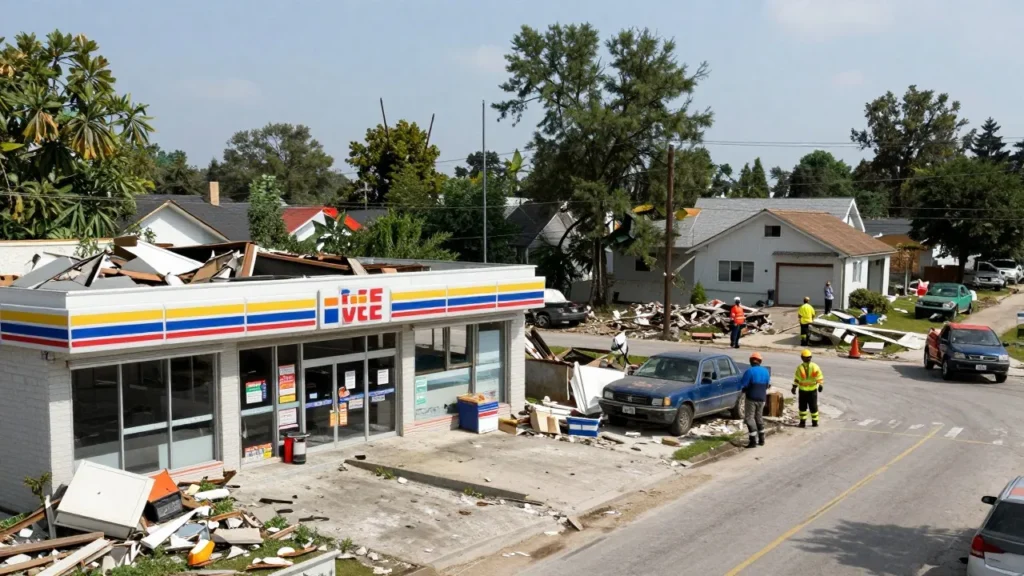
There is no single U.S. criminal statute that governs every state. Definitions, offenses, and penalties depend on the jurisdiction and the facts of each case.
Some jurisdictions have laws that specifically address theft or burglary committed during declared emergencies or evacuation periods. These provisions show how an ordinary property offense can carry additional legal consequences because of its timing and circumstances.
That does not mean every state uses the same definition or punishment. Anyone facing an actual criminal charge should review the law that applies in the jurisdiction where the event occurred and seek qualified legal advice. For a closer look at this, see Defendant Definition.
Konthly’s broader Law section includes other plain-language explanations of legal concepts.
Wartime Pillage Is a Different Legal Category
Armed conflict changes the legal framework. Under international humanitarian law, pillage is prohibited and may constitute a war crime.
The rule concerns the unlawful appropriation of property during armed conflict, not ordinary peacetime shop theft. It may involve private property and, in some circumstances, culturally significant objects.
This distinction also explains why reports about stolen artifacts, occupied towns, or property taken by armed forces often use terms such as “pillage” or “plunder.” Those words carry a specific wartime context.
A Four-Question Context Check for Reading a Headline

Before accepting a crime label in a breaking-news story, ask four questions:
- Was property taken without the owner’s permission? Confirm that property was taken rather than relying on an image, assumption, or rumor.
- Was force or a threat used against a person? That fact may distinguish theft from robbery.
- Was unlawful entry involved? Entry into a store, home, or other protected place may change the legal issue.
- What was the surrounding event? A riot, declared emergency, evacuation, or armed conflict may trigger different legal rules.
Konthly’s profile of Jason Vukovich offers another example of why motive, conduct, punishment, and public opinion should be treated as separate questions in crime-related stories.
Read the Context Before Accepting the Label
When you encounter the term in a headline, start with the conduct rather than the emotion surrounding the event. Ask what was taken, who owned it, whether force or unlawful entry was involved, and what legal setting applied.
That approach makes it easier to separate property crime from protest activity, disaster rumors, and wartime offenses. For more explainers that put unfamiliar subjects into plain language, browse Konthly’s Education section.
Frequently Asked Questions
No. Robbery generally involves taking property by force or by threatening a person. The broader crisis-related term can describe property being taken without that confrontation. Exact criminal definitions still depend on local law.
No. The term can appear in reports on civil disorder, natural disasters, evacuations, war, and other situations in which normal property protections have been disrupted.
No. Research does not support the idea that widespread theft automatically follows every disaster. The scale and type of antisocial behavior vary according to the event and surrounding circumstances.
Pillage is the unlawful appropriation of property during armed conflict. International humanitarian law prohibits it, and serious violations may amount to war crimes.
Yes. Criminal statutes differ by jurisdiction. An emergency may also trigger special provisions or sentencing rules, so the applicable local law and the facts of the case matter.