
A Balrog is one of J.R.R. Tolkien’s most dangerous supernatural beings. These creatures began as Maiar before Morgoth corrupted them into servants of shadow and fire. American audiences know Durin’s Bane best from its unforgettable confrontation with Gandalf in Moria.
Tolkien gave these beings a history reaching far beyond The Lord of the Rings. Their story connects Morgoth, the First Age, Gondolin, Khazad-dûm, and several legendary Elven heroes. Understanding that history explains why Gandalf treated the creature beneath Moria as a threat unlike ordinary monsters.
| Quick fact | Details |
| Nature | Corrupted Maia, a powerful spiritual being |
| Master | Morgoth, originally called Melkor |
| Famous example | Durin’s Bane |
| Main weapons | Fiery whip and, in some accounts, a sword |
| Known leader | Gothmog, Lord of Balrogs |
| Famous location | Moria, formerly Khazad-dûm |
| Primary traits | Shadow, fire, terror, immense supernatural power |
| Tolkien name meaning | Commonly translated as “Demon of Might” |
| Major books | The Lord of the Rings and The Silmarillion |
These fire demons were corrupted Maiar who entered Morgoth’s service before much of Middle-earth’s recorded history. They fought some of the greatest Elves of the First Age. One survivor later hid beneath the Misty Mountains, became Durin’s Bane, and eventually fought Gandalf during the Fellowship’s journey through Moria.
What Is a Balrog in Tolkien’s Legendarium?
These Balrog creatures were not simply giant animals that happened to control fire. They belonged to the Maiar, the same broad spiritual order that included figures such as Gandalf and Sauron. Their supernatural origin helps explain why ordinary warriors rarely had any chance against them.
Tolkien described them as terrible servants whom Melkor corrupted in the world’s earliest days. Melkor later became known as Morgoth, the first Dark Lord. The corrupted spirits eventually became among his most feared military servants.
The Sindarin name is commonly translated as “Demon of Might” or “Demon of Power.” Its Quenya counterpart is Valarauko, with Valaraukar used as a plural form. Tolkien revised some linguistic details during his long development of Middle-earth.
Where Did Tolkien’s Fire Demons Come From?
Their history begins before the famous kingdoms of Elves, Men, or Dwarves reached their later forms. Melkor attracted powerful spirits as he built his forces against the other Valar. Several spirits associated with fire became loyal to him and eventually took their fearsome demonic forms.
They remained connected with Morgoth’s northern strongholds, including Utumno and later Angband. When Ungoliant threatened Morgoth after the destruction of the Two Trees, his servants rescued him. That episode shows their importance long before the wars most movie viewers know.
During the First Age, they fought in major conflicts against the Noldor and their allies. Their appearances were often tied to disasters, important deaths, or the destruction of great kingdoms. They were commanders and supernatural weapons rather than ordinary frontline soldiers.
What Did These Creatures Look Like?
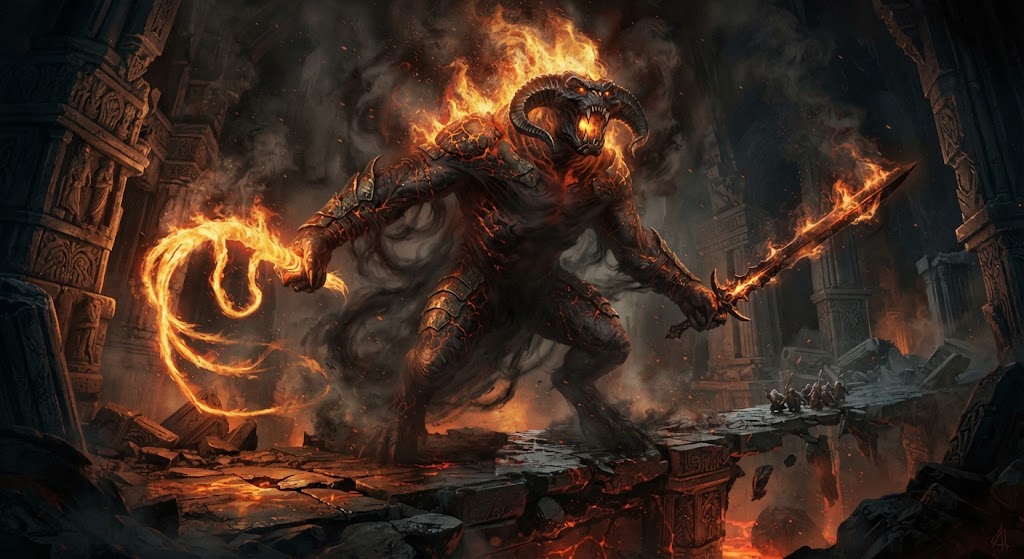
Tolkien’s descriptions emphasize darkness, flame, fear, and a roughly human-shaped form. The being encountered in Moria appears surrounded by shadow while fire becomes visible around its body. Its presence itself creates terror before its full appearance becomes clear.
The fiery whip is their most recognizable weapon. Other texts and traditions also associate individual members with blades or other weapons. Gothmog, for example, is commonly described in Tolkien reference material with a black axe and whip.
Modern screen adaptations often make the creature enormous, heavily armored, and covered with blazing cracks. Those visual choices are interpretations, not exact measurements supplied by Tolkien. His prose leaves important physical details open to the reader’s imagination. Fans of big-screen fantasy franchises may also enjoy Konthly’s Mark Hamill profile.
How Powerful Were They?
Their Maia nature placed them far above most physical creatures encountered across Middle-earth. They combined physical strength with supernatural terror and an affinity for shadow and fire. Tolkien also suggests that at least some could oppose magical power used against them.
Their battle record also demonstrates their danger. Gothmog mortally wounded Fëanor and later killed Fingon during the First Age. Other famous encounters ended with both the demon and the heroic opponent dying.
That pattern matters when considering Gandalf’s decision at the Bridge of Khazad-dûm. He did not ask Aragorn, Boromir, or another fighter to take his place. His own nature as a Maia made the confrontation fundamentally different from an ordinary battle.
Durin’s Bane and the Fall of Khazad-dûm
One surviving fire demon escaped the destruction surrounding Morgoth’s defeat. It eventually hid deep beneath the Misty Mountains, near the great Dwarven realm of Khazad-dûm. It remained concealed there for thousands of years.
The Dwarves encountered the creature during the Third Age while mining beneath their kingdom. It killed King Durin VI in the Third Age in 1980 and later killed Náin I. The devastated Dwarven stronghold became widely known as Moria, meaning the Black Chasm.
This history gave rise to the name Durin’s Bane. The dwarves knew something terrible had destroyed their kingdom before anyone understood its true identity. The creature remained beneath Moria until the Fellowship entered those ancient halls.
Why Did Gandalf Fight Durin’s Bane?
Gandalf recognized the danger once the creature emerged during the Fellowship’s escape. Their confrontation reached its famous turning point on the narrow Bridge of Khazad-dûm. Both fell into the depths after the bridge broke during their struggle.
Their fight did not end with the fall. Gandalf later explains that the pursuit continued through deep passages before reaching the mountain peak. He finally defeated his enemy but died from the ordeal before being sent back as Gandalf the White.
The encounter works because the two opponents share a deeper supernatural connection. Both belong to the Maiar, although they chose radically different paths. One served the Free Peoples, while the other had been corrupted by Morgoth ages earlier.
Did Tolkien’s Fire Demons Have Wings?
The wings question remains one of Tolkien fandom’s longest-running debates. The controversy comes from wording in the Moria chapter that compares spreading shadow with enormous wings. A later description then refers to “wings” without repeating the earlier comparison.
Readers therefore disagree about whether Tolkien intended physical wings or continued the shadow imagery. The text never provides an unambiguous anatomical explanation that ends the argument. Tolkien also never clearly establishes these creatures flying during the events in question.
Peter Jackson’s film version gives Durin’s Bane a strongly wing-like silhouette. That design helped shape how millions of viewers picture the creature today. It should still be separated from conclusions that can be proven from Tolkien’s written descriptions.
Who Was Gothmog, Lord of the Balrogs?
Gothmog was the most prominent named member of Morgoth’s fiery servants. Tolkien identifies him as their lord and as the high-captain of Angband. His actions make him one of the most dangerous military figures serving Morgoth during the First Age.
He played a role in the deaths of several major Elven figures. His victims included Fëanor and Fingon, while he also participated in the capture of Húrin. Gothmog finally died during the Fall of Gondolin while fighting Ecthelion.
Durin’s Bane is much more familiar to general audiences because of The Lord of the Rings. Gothmog matters more when examining the broader history in The Silmarillion. Together, they show how these creatures affected very different periods of Tolkien’s mythology.
How Many Existed?
Tolkien’s ideas about their numbers changed considerably while he developed his mythology. Early writings describe large groups, while later concepts reduced their numbers dramatically. Reference works often discuss a later idea that only a small number existed.
For that reason, presenting one exact total as permanently settled can be misleading. The published material does establish that several operated under Morgoth during the First Age. It also establishes that some survived his final defeat by escaping into hidden places.
Durin’s Bane is the only survivor whose later history receives a detailed narrative. Tolkien does not provide equally complete Third Age stories for other possible survivors. That uncertainty remains part of the mythology rather than a gap later adaptations can automatically resolve.
Why the Creature Still Matters to The Lord of the Rings
The Moria sequence changes the Fellowship’s journey and removes Gandalf at a crucial moment. It also gives readers their clearest glimpse of powers surviving from Middle-earth’s remote First Age. The monster therefore connects the immediate quest with a far older history.
Its popularity also shows Tolkien’s ability to suggest more history than he directly explains. Movie viewers can understand the scene as a terrifying monster encounter. Readers who investigate further discover Maiar, Morgoth, Gondolin, Gothmog, and thousands of years of hidden history.
For more film, television, and franchise coverage, browse Konthly’s Entertainment section. Genre fans can also explore the site’s Rex Linn feature. These pages provide additional entertainment reading for U.S. visitors.
The Takeaway
Tolkien made these beings frightening because their history was much larger than their physical appearance. They were fallen spiritual powers carrying the violence of Morgoth’s First Age into later centuries. Moria turned that ancient threat into one of fantasy literature’s most recognizable confrontations.
Knowing their origin makes Gandalf’s stand on the bridge more meaningful. He was facing a corrupted being from the same supernatural order as himself. That connection turns the scene from a monster fight into a collision between two ancient powers.
Frequently Asked Questions
Is a Balrog a demon or a Maia?
It is a Maia that became a demonic servant of Morgoth. “Demon” describes its corrupted identity, while Maia describes the spiritual order it originally belonged to. This distinction explains why the creature has far greater power than a normal monster.
Is Durin’s Bane the same creature Gandalf fights?
Yes, Durin’s Bane is the creature Gandalf confronts beneath Moria. It received that name after killing Durin VI during the Third Age. The same being later fought Gandalf from Khazad-dûm to the mountain peak.
Are these fire demons stronger than dragons?
Tolkien presents both groups among Morgoth’s most destructive servants, but direct comparisons are difficult. Their abilities, roles, and individual strengths differ across the legendarium. A simple power ranking would claim more certainty than Tolkien’s texts provide.
Could they fly?
Tolkien never clearly shows one flying in the central narratives. The famous wing descriptions can be read as imagery involving the creature’s spreading shadow. That ambiguity created a debate that remains active among readers.
Was Durin’s Bane the last one alive?
The texts do not establish that conclusion with complete certainty. Tolkien wrote that some of Morgoth’s servants escaped and hid after the War of Wrath. Durin’s Bane is simply the surviving member whose later fate is clearly recorded.