

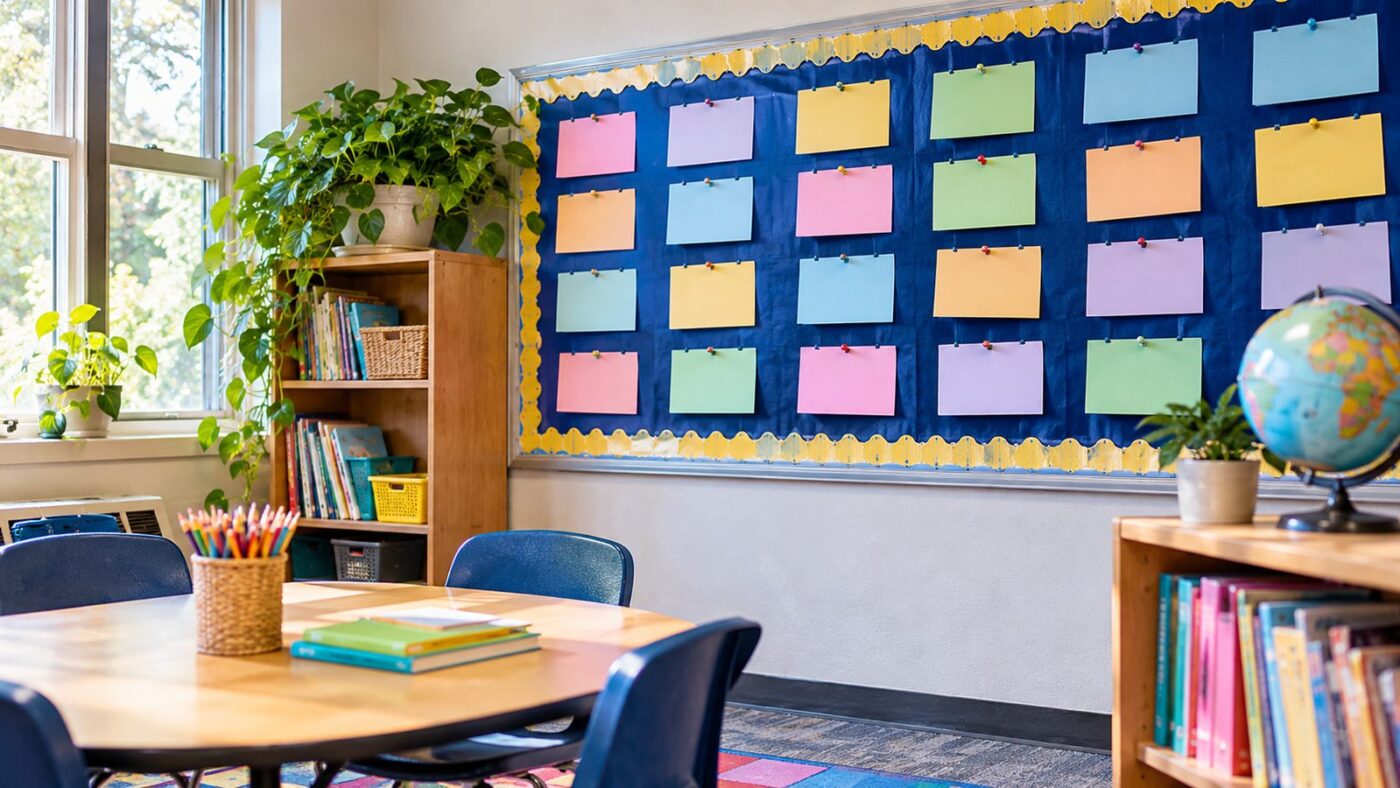
Vocabulary word walls give students an organized display of words they need often. A useful wall supports reading, writing, speaking, and subject-area learning. The strongest displays become working classroom tools rather than permanent decorations. Direct answer: A vocabulary word wall is an organized display of important words students regularly read, discuss, and use. Teachers can group words alphabetically or by concept. Effective displays add words gradually, explain them in student-friendly language, include helpful visuals, and become part of daily classroom activities.
| Planning question | Practical starting point |
|---|---|
| Main purpose | Keep useful words visible and available |
| Typical pace | About five new words per week |
| Best organization | Alphabetical for quick lookup or conceptual for relationships |
| Helpful card elements | Word, visual, short definition, example sentence |
| Daily use | Review, sorting, games, discussion, and writing |
| ELL supports | Pictures, cognates, home-language connections, oral practice |
| Assessment | Listen for use, check writing, and use short retrieval tasks |
| Maintenance | Remove, archive, or rotate words when the display becomes crowded |
What Is a Vocabulary Word Wall?
A classroom word wall is a visible collection of words selected for instruction. Students should be able to find and use the words during normal classwork. The display works best when teachers refer to it frequently. The words can support several different learning goals. Younger children may need high-frequency words for reading and writing. Older students may need academic terms that unlock math, science, or social studies lessons. Research guidance supports active vocabulary teaching rather than passive exposure alone. The National Reading Panel’s 2000 report found value in direct and indirect vocabulary instruction. It also emphasized repeated encounters with words and varied instructional methods. That evidence does not prove that a wall alone improves comprehension. A display is better understood as one tool within broader vocabulary instruction. Its value depends largely on what students do with the displayed language.
Four Types of Classroom Word Displays
Different classrooms need different kinds of displays. The best format depends on age, curriculum, and instructional purpose. Teachers can also combine formats during the school year.
High-frequency and sight-word walls for K to 2
Primary classrooms often display words children encounter repeatedly in reading and writing. Examples include the, said, come, where, and because. Teachers can organize these words alphabetically for quick reference. The display should support instruction rather than replace phonics teaching. Students still need systematic work with sounds, spelling patterns, and decoding. The wall gives them a reference for useful words they have already studied.
Content-area academic vocabulary walls
Math, science, and social studies classrooms benefit from subject-specific terms. A science wall might connect organism, habitat, and ecosystem. A math display might group numerator, denominator, and fraction around one concept. Conceptual organization can be more useful than alphabetical order here. Students see relationships between ideas instead of isolated definitions. A social studies wall might even include legal terms, with a plain-language definition of defendant as a model card. Those connections also support classroom discussion and written explanations.
Interactive word walls
An interactive display lets students sort, move, group, and connect word cards. Students might arrange terms by category or sequence. They can also draw arrows showing cause, structure, or relationships. Some classroom research has examined this approach in middle school science. Interactive walls commonly combine vocabulary with visual representations and conceptual organization. They are designed to make students work with meanings instead of merely seeing words.
Digital word walls
A digital version can use shared slides, classroom documents, or an online board. Each entry may include a word, image, pronunciation, definition, or student example. Teachers can organize entries by unit, topic, or letter. Digital displays are useful when students need access outside the physical classroom. They also make revision and archiving easier. Keep the layout simple enough that students can locate a term quickly.
How to Set Up Vocabulary Word Walls
A strong display starts small and grows alongside instruction. Posting an entire semester’s vocabulary on the first day creates clutter. Introduce terms when students have enough context to understand them.
- Choose a clear instructional purpose. Decide whether students need high-frequency words, academic language, content terms, or another focused group.
- Select a manageable number of words. About five new words per week is a useful general starting point. Adjust the pace for your students and subject.
- Choose the layout. Alphabetical organization helps students find words quickly. Concept maps work better when relationships between terms matter.
- Write student-friendly definitions. Use language students already understand. Avoid replacing one difficult term with several other difficult words.
- Add meaningful visuals. Use pictures, diagrams, symbols, or small examples when they clarify meaning. Visuals are especially useful for younger learners and ELLs.
- Include an example sentence. Show the term in the type of sentence students might read or produce. Content-area examples should reflect the current unit.
- Introduce every word before posting it. Say it, explain it, discuss it, and use it in context. Students should know why the word belongs there.
- Build daily interaction into instruction. Point to the display during discussion, reading, and writing. Encourage students to use it without waiting for teacher prompts.
Alphabetical or Concept-Map Layout?
Alphabetical displays work well when quick retrieval matters. A student who forgets how to spell because can look under B. This structure is familiar and easy to maintain. Concept maps are stronger when the goal involves relationships. A science teacher could place photosynthesis near chlorophyll, sunlight, and glucose. Arrows or labels can show how those ideas connect. Some teachers use both systems. A K to 2 classroom may keep high-frequency words alphabetically. A separate science or social studies section can organize unit vocabulary by concept.
Daily Word Wall Activities That Take Only Minutes
The display becomes useful through repeated student interaction. Short routines can fit into transitions, lesson openings, or review periods. Rotate activities so practice stays purposeful.
- Word wall bingo: Students identify words from definitions, examples, pictures, or clues.
- Guess my word: Give several clues while students determine which displayed term fits.
- Chants and oral review: Read, spell, clap, or rhythmically repeat selected words.
- Sorting: Students group cards by meaning, topic, structure, part of speech, or another feature.
- Writing challenge: Require students to use selected terms accurately in a short response.
- Connect two words: Students explain a meaningful relationship between two displayed terms.
- Find the evidence: Students locate a target word in a class text and explain its meaning there.
These routines create repeated encounters with vocabulary. They also shift students from recognition toward actual use. A word becomes more valuable when students can apply it independently.
Grade-Band Example Word Lists
The right words come from your curriculum and students’ needs. These lists show how focus changes across grade bands. They are examples rather than required sequences.
| Grade band | Possible words | Instructional focus |
|---|---|---|
| K to 2 | said, where, come, because, little, again, friend, were | High-frequency reading and writing |
| Grades 3–5 | compare, contrast, evidence, summarize, estimate, factor, habitat, region | General and content-area academic language |
| Middle school science | organism, ecosystem, variable, density, molecule, force, adaptation, photosynthesis | Concept relationships and scientific explanations |
Teachers should favor words students will need repeatedly. A long collection of rare terms can become visual noise. Fewer useful words usually produce better daily practice.
Supporting English Language Learners
ELLs often benefit from added visual and language connections. Pair a new term with a clear image whenever the image adds useful meaning. Gestures, examples, real objects, and diagrams can provide more context. Cognates can also help when English shares a related word with a student’s home language. For example, energy connects easily with Spanish energía. Teachers should verify cognates because similar-looking words do not always share meanings. Invite students to add home-language connections when appropriate. That practice treats existing language knowledge as a learning resource. It can also make the display more accessible during oral and written work.

Keep the Display Useful, Not Cluttered
A wall containing hundreds of equally prominent cards becomes difficult to scan. Students may stop looking at it because finding a term takes too long. Regular maintenance protects the display’s purpose. Archive older words after students use them confidently. You can move them to a smaller reference section or a digital archive. Unit-specific words can also rotate when the class changes topics. Color should communicate meaning instead of decoration. One color might identify math terms and another science terms. Too many colors, fonts, borders, and pictures can compete with the words themselves.
How to Assess Whether Students Are Using It
Do not measure success by how full the wall looks. Watch whether students use its language during authentic classwork. Listen during partner discussions and examine written responses. You can also run quick retrieval checks. Ask students to define a term, choose an example, or connect two displayed words. Exit tickets can reveal which words still need instruction. Writing provides another useful measure. Compare students’ vocabulary use across several assignments rather than one worksheet. Accurate, independent use suggests that the words are becoming part of students’ working language.
A Social Studies Extension for Older Students
Older students can study how definitions change with context. Legal and civic vocabulary offers strong examples because familiar words may carry specific meanings. Konthly’s Education section can provide additional plain-language reference material. For example, students could compare everyday and formal uses of defendant. Konthly’s explanation of that term distinguishes civil and criminal meanings. Teachers could use a similar routine with terms tied to public events. The site’s plain-language explainer on looting separates the word from related terms such as robbery and rioting.
What Research Can and Cannot Tell Us
Vocabulary knowledge is closely connected with reading comprehension. The National Reading Panel reviewed vocabulary research as part of its 2000 reading report. Its conclusions favored direct teaching, indirect learning, repeated exposure, and active engagement. The report also called for more research on the strongest vocabulary methods and combinations. That caution still matters when discussing classroom displays. Teachers should avoid claiming that hanging word cards automatically raises reading scores. A more defensible approach treats the display as a support for sound instruction. Students need explanations, context, retrieval, discussion, and repeated use. The wall keeps important language visible while those activities happen.
Frequently Asked Questions
How many words should I add each week?
About five words per week is a common starting guideline for vocabulary word walls. Gradual additions work better than overwhelming students with a long list. Change the pace when your curriculum or learners require it.
Should a classroom display be alphabetical?
Not always. Alphabetical organization is helpful for spelling and quick reference. Conceptual groupings are often stronger for science, math, and other content vocabulary.
Do digital versions work differently?
The instructional goal stays the same. Students still need repeated encounters and chances to use each term. Shared slides or online boards mainly change how the resource is accessed.
Should students help create the wall?
Student participation can make the display more interactive. Learners can suggest examples, add illustrations, or sort cards into meaningful groups. Teachers should still guide word selection and correct misconceptions.
Can a word wall replace vocabulary instruction?
No. The display is a reference and practice tool, not a complete vocabulary program. Students still need explicit explanations, varied contexts, discussion, reading, and writing.
Make the Wall Part of the Lesson
A classroom word display earns its space when students use it. Select a small set of useful words, teach them clearly, and return to them often. Let students speak, sort, connect, and write with the language. Keep the system simple enough for students to navigate independently. Remove or archive words that no longer need prime space. A focused working resource is more useful than a crowded bulletin board. Start with the next five important words in your current unit. Create clear cards and plan one brief activity for each school day. By Friday, you should know which terms students can use and which need more teaching. —